
Using Design for Community Innovation in Blaenau Ffestiniog
How can communities shape the way their stories are told, and how can design help make that happen?
We’ve been working with partners across Wales as part of the AHRC-funded Community Innovation Practitioner (CIP) programme to explore these questions. Led by Shirish Kulkarni at Cardiff University through Media Cymru, the project, Newyddion i Bawb, focuses on developing more appropriate information and news services for under-served audiences.
In collaboration with Cardiff University, Common/Wealth, S4C and Cymru Creadigol | Creative Wales, the project centres on Blaenau Ffestiniog. Drawing on our expertise in service design and design research, we explored how an information creation and sharing service might work for this community, and what can be learned for others facing similar challenges.
What’s design got to do with this?
Design is fundamentally about solving complex problems through deep engagement with the people affected by them. Rather than starting with how Blaenau Ffestiniog should be represented in the news, we reframed the challenge. Using co-design and systems thinking approaches, we began by exploring the community’s lived experiences and identifying their underlying information and communication needs.
This shift allowed us to examine how journalism and mass media influence identity, trust and participation, moving beyond a narrow definition of ‘news’. Instead, we positioned information as part of the foundational economy: the everyday systems that enable communities to function and thrive.
Working alongside the community
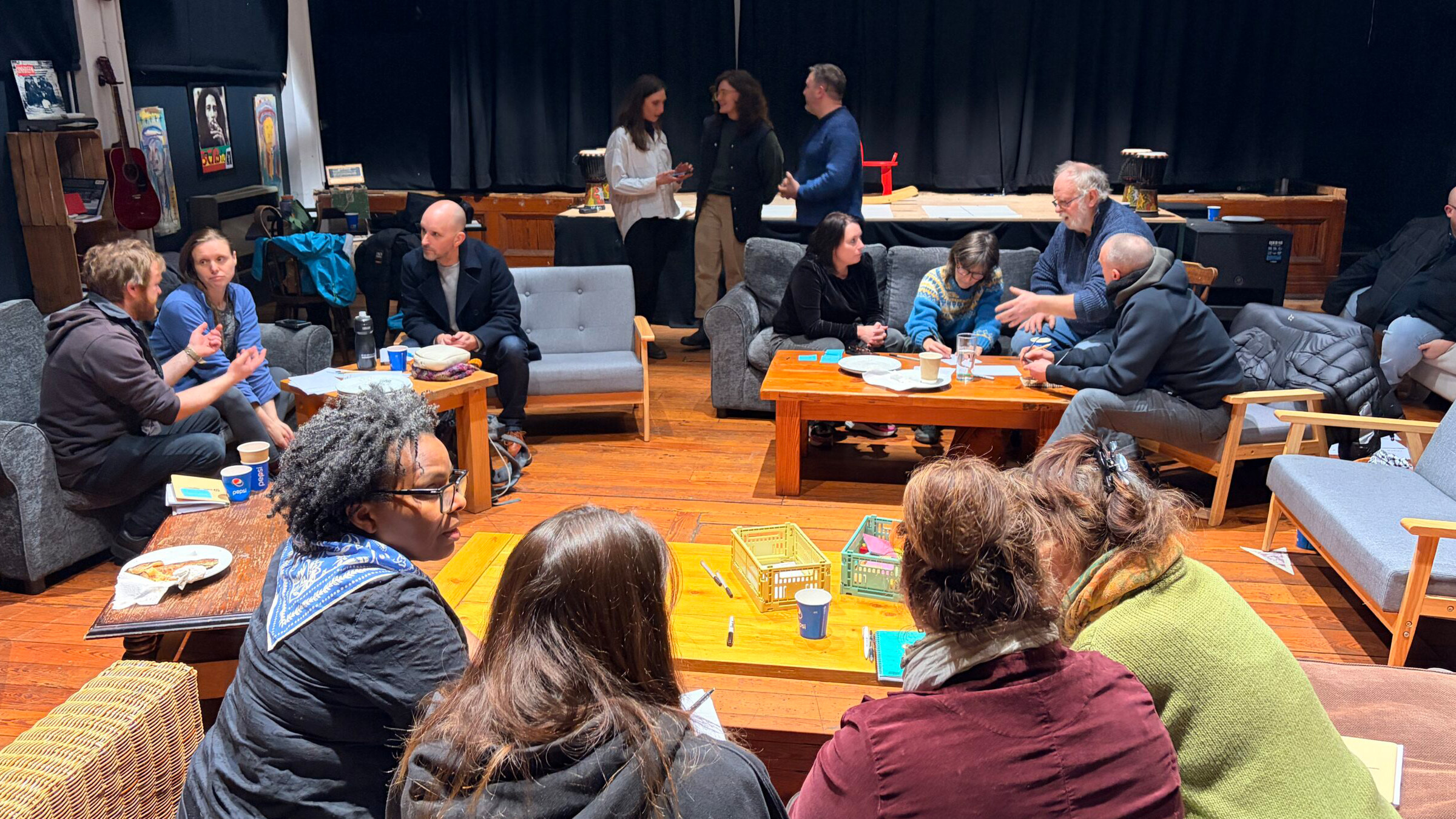
Over three weekends (held in November 2025, January and February 2026), PDR’s Andrew Walters and Jo Ward facilitated a series of structured co-design workshops at Cellb, a community arts hub in Blaenau Ffestiniog, involving around 20 local participants from a range of backgrounds and experiences.
We delivered these sessions collaboratively alongside creative writing and theatre workshops led by Common/Wealth, whose expertise in community storytelling helped surface powerful reflections on personal identity as well as how media portrayals, both positive and negative, have shaped local identity.
Building on this foundation, we introduced practical design tools to:
- Understand the needs of the community
- Map local information flows
- Identify service gaps and barriers
- Reframe challenges from a systems perspective
- Generate and test early-stage concepts
Participants were encouraged to engage others beyond the workshop group, extending insight gathering into the wider community through activities in sessions as well as the community events designed and organised by the group on separate weekends. This blend of creative practice and structured design research created both emotional depth and practical direction.
From representation to action
As the work progressed, it became clear that the community’s needs were wider than simply improving ‘news’ coverage. While representation matters, the stronger priority was enabling better local information sharing, supporting collaboration, building confidence and strengthening collective agency.
Through structured ideation and rapid concept development, ideas emerged including:
- Self-sustaining community kitchens
- Shared educational resources
- Local knowledge-sharing initiatives
- Making existing initiatives more visible to more people
Crucially, these were developed into initial action plans led by community members, including identifying potential funding routes and next steps. Here, our use of design thinking and processes enabled the community to translate insight into implementable action.
A prototype for community-led innovation
This work serves as a prototype for a model of engagement that goes beyond consultation. By combining creative engagement with service design methods, the project equipped participants with tools, confidence and structure to define problems, generate viable concepts and take ownership of delivery. For public bodies, broadcasters, cultural organisations and third-sector partners, this demonstrates how design can:
- Build trust with under-served communities
- Surface systemic challenges
- Translate insight into feasible service concepts
- Support the development of sustainable social enterprises
For us, design is not simply about representation – it’s about enabling agency and creating practical pathways for change. If your organisation is exploring new service models, tackling complex community challenges or seeking more meaningful engagement approaches, we can help you move from conversation to action.